
Trinity Tour


Sunday Services
We meet for worship at 10.30am and 5.30pm

Through this tour we invite you to delve with us into the legacy of those who have yielded to us a rich inheritance of truth.
Whether you take it all in at once or dwell a while on one aspect of our forbears, we commend the good news of Jesus Christ to each and every one of us who now occupy these halls. Join us in prayers of gratitude for those who went before us, as well as for the gospel partners who have enabled this magnificent renovation through their kindness flowing so generously from their love for God. Please do pray for those of us engaged in the work of the gospel here today, and for generations to come, God willing, who will follow us in this privilege.
Trinity’s building was purchased from Queen Street Church of Scotland in September 2018. During its lifetime it has changed denomination and name on more than one occasion. This interesting history of unions and congregational mergers is part of the changing landscape of religious life in Scotland in the twentieth century. The arrival of several different congregations into this building over the years means that the building holds a beautiful array of ecclesiastical furniture, artefacts, and photographs which we have restored and researched as fully as we can.
Same place, different names
Christian worship has taken place on this site since at least as far back as 1764. With the Disruption of 1843 throughout Scotland, a congregation departing the North Parish Church (now Aberdeen Arts Centre since 1963) erected a small building on this site on 1844 facing onto West North Street and named themselves Aberdeen Free North Church. In 1900 the Free Church united with the United Presbyterian Church to become the United Free Church; Aberdeen Free North was part of this union, and by 1902 it was known as the North United Free Church. By this time they had outgrown their premises which were subsequently demolished and the present building was erected.
This new building, by the architect William E. Gauld, an office-bearer in the congregation, covered the site of the first church and also new land in Queen Street which had been purchased for £715 (a little over £110,000 in today’s money). The City Archives in Aberdeen Town House hold a letter dated 19th August 1904 from the Deacon’s Court thanking a solicitor, W. McQueen-Smith, for conveyances of land around 79-83 Queen Street for £2115 in order to build the church. Its Memorial Stone was laid on Saturday 10th September 1904, and it was opened for worship on 1 September 1905.
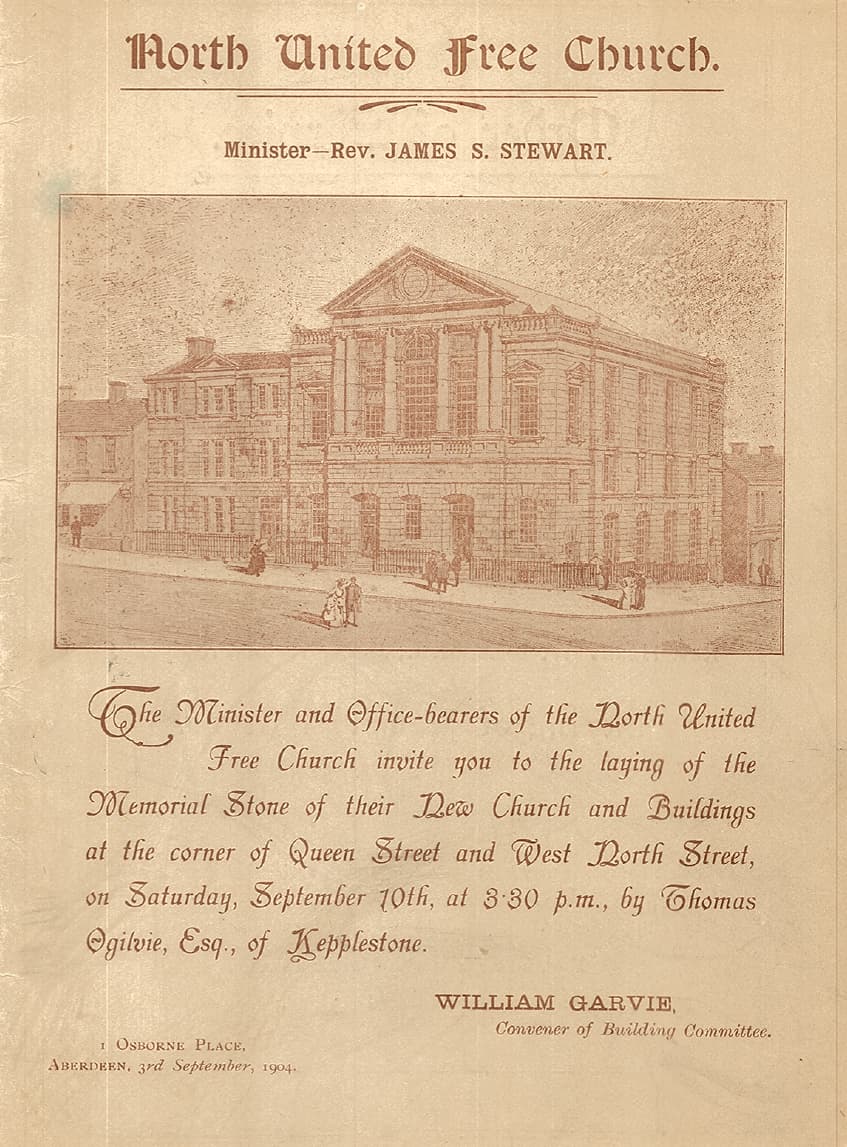
It remained the North United Free until 1929 when the majority of the United Free congregations joined with the Church of Scotland in an attempt to heal the divisions within Scottish Presbyterianism. From 1929-1967 the church was known as the North Church of Scotland.
In 1967, however, St Andrew’s Church on King Street was united with the congregation and the church was renamed the North Church of St Andrew. (St Andrew’s was sold to the Assemblies of God denomination and subsequently became King’s Community Church. Trinity rented this building from 2021-2026 while we waited for the renovation project to complete).
Continue Reading
December 2004 saw Greyfriars John Knox unite with the North Church of St Andrew, with independent arbiters deciding that the Queen Street premises should be the one used by the united congregation. Queen Street Church became its name then, which it remained until sold to Trinity Church in 2018, with the title deeds transferring to Trinity’s registered Scottish charity The Cruden Trust. (Greyfriars John Knox was itself a union of John Knox Church and Greyfriars Church in 1997. Several artefacts from both these churches found their way into our building. This included a stained glass window of John Knox which was the only item the departing Queen Street congregation in 2018 asked to follow them to their new home of St Mark’s. The communion table currently in use by Trinity came from John Knox Church and was itself made from the original pulpit in John Knox).
After the purchase of this building in 2018 we embarked on a comprehensive renovation and restoration project. This was delayed by the Covid-19 pandemic and dramatic price rises due to war in Ukraine, but eventually completed in early 2026.
Timeline of names
For a goldmine of information on the building’s history and its Ministers, see:
The Churches of Aberdeen: Historical and Descriptive by Alexander Gammie (1909)

RENOVATION PROJECT
In September 2018, we purchased Queen Street Church in the heart of Aberdeen’s city-centre and we set about renovating and restoring the premises as Trinity’s permanent church home for generations to come.
If you have any questions or require any further information about the building project, please email building@trinityaberdeen.org.uk.
SPACES
Our renovation of the premises, completed in March 2026, has attempted to fully update every part of the church while preserving and protecting its various histories and telling something of the stories that have echoed within its walls for over a century.
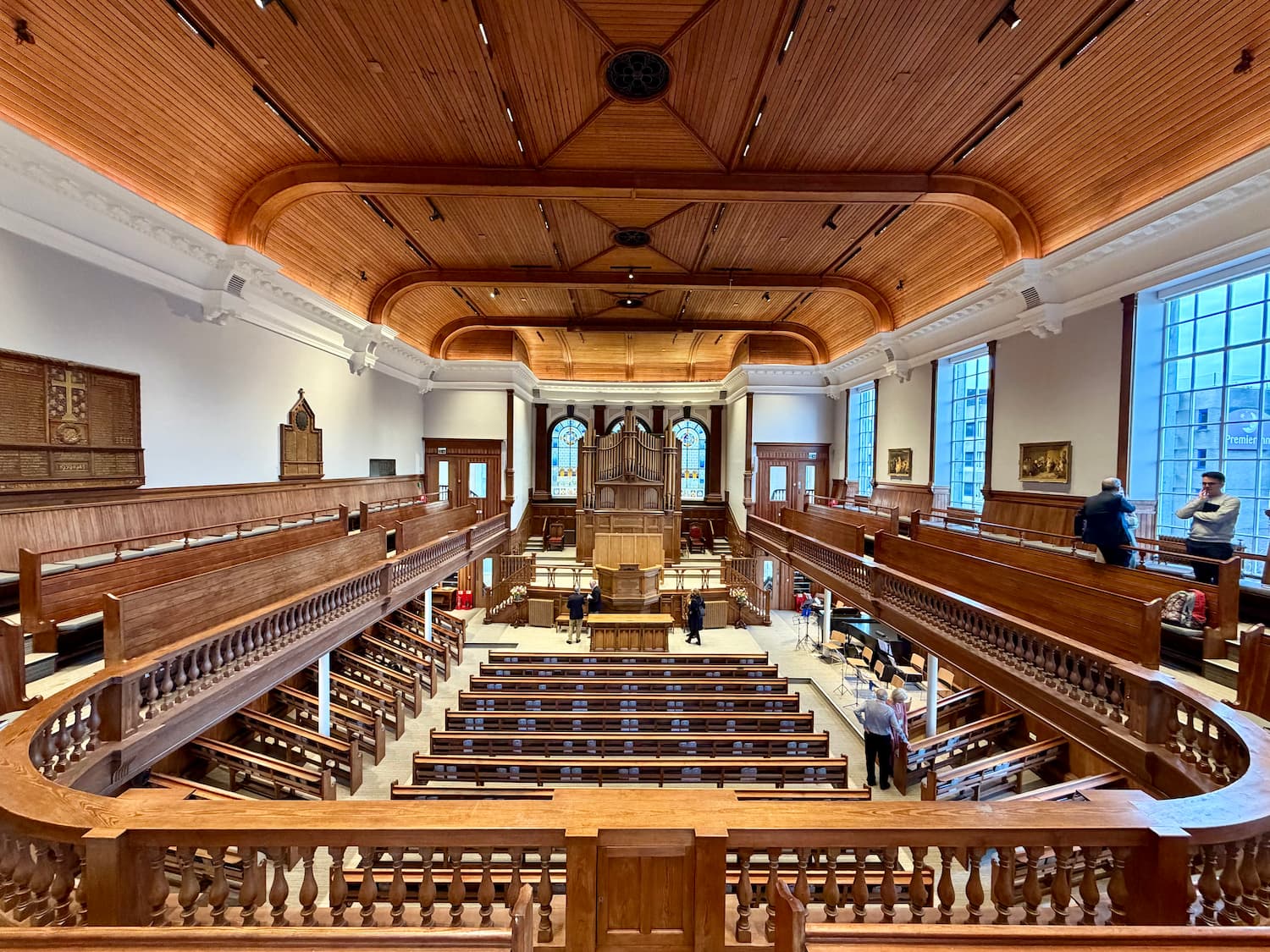
St Andrew Hall

Cruden Hall
Alexander Cruden (1699-1770)

Rutherford Hall
Samuel Rutherford (c1600-1661)

Schaeffer Library
Francis Schaeffer (1912-1984)

Martin Room
Hugh Martin (1822-1885)

Marischal Room
George Keith (1554–1623), the 5th Earl Marischal

Knox Room
John Knox (c1514-1572)

Murray Lounge
Rev Dr John Murray (d. March 1861)

Wishart Room
George Wishart (c1513-1546)

Greyfriars Loft

‘Baptism in Scotland’ (1850)
Aberdeen Art Gallery
John Phillip (1817-67)

‘Presbyterian Catechising’ (1847)
National Galleries of Scotland
John Phillip (1817-67)

‘The Covenanters’ Communion’ (1840)
National Galleries of Scotland
Sir George Harvey (1806-1876)